
Travel Blog
Why USA Citizens Pay $100 for Tanzania Visa (Not $50): The Multiple Entry Requirement Explained

Why USA Citizens Pay $100 for Tanzania Visa (Not $50): The Multiple Entry Requirement Explained
So, you’re planning your dream safari to Tanzania; maybe you want to witness the Great Migration across the Serengeti, climb Mount Kilimanjaro, or relax on Zanzibar beaches. You start researching visa requirements and notice something odd: most travelers pay $50 for a Tanzania tourist visa, but as an American citizen, you’re required to pay $100 for a “multiple entry visa.”
What gives? Why do US citizens have to pay double? And what exactly does “multiple entry” even mean if you’re only planning one trip?
I’ve worked with many American travelers heading to Tanzania, and this is hands down the most common question I get. Let me clear up the confusion once and for all with the real facts, official data, and insider insights you need.
USA Citizens: Why You Need a Multiple Entry Tanzania Visa: What US Citizens Need to Know
Here's the reasons, straight from Tanzania's official Immigration Services:
- Cost: $100 USD (not the standard $50) – This is mandatory for all US passport holders entering Tanzania for tourism.
- Visa Type: Multiple Entry Visa – You CANNOT get the single-entry “ordinary visa” even if you only plan to visit once.
- Validity: 12 months from date of issue – You can enter and exit Tanzania as many times as you want within one year.
- Stay Duration: Up to 90 days per visit – Each individual stay cannot exceed 90 consecutive days, but you can leave and return.
According to the official Tanzania Immigration Department website, “Nationals from America (USA) who wish to visit Tanzania for holiday or tourism are required to apply for Multiple Visa” regardless of their travel plans. There are no exceptions to this policy.
Why Do US Citizens Pay $100? Understanding the Reciprocity Agreement
The $100 fee isn’t arbitrary, it’s based on a bilateral reciprocity agreement between Tanzania and the United States. Here’s how it works:
What Is Visa Reciprocity?
Visa reciprocity means that countries mirror each other’s visa policies. When the United States grants Tanzanian citizens a one-year, multiple-entry tourist visa, Tanzania does the same for American citizens. It’s a diplomatic tit-for-tat arrangement designed to maintain fairness and equality in international travel relations.
According to the US State Department’s official reciprocity schedule for Tanzania, when Tanzanian citizens apply for a US tourist visa (B1/B2), they receive:
- A multiple-entry visa valid for 12 months
- $160 USD non-refundable application fee (all applicants pay this regardless of approval)
- No additional visa issuance fee for Tanzanian nationals
In return, Tanzania grants US citizens the same 12-month multiple-entry access. The $100 fee is Tanzania’s visa issuance charge, lower than the $160 Americans charge for processing, but still double what most other nationalities pay for Tanzania’s standard single-entry visa.
The key difference? Most countries pay $50 for a 90-day single-entry visa. US citizens pay $100 for a 12-month multiple-entry visa. It’s technically “more” visa for your money, even if you only use it once.
Is the $100 Multiple Entry Visa Actually Worth It?
I get it paying an extra $50 feels frustrating when you’re only planning a single safari. But here’s the thing: that multiple-entry visa might actually save you money and hassle down the road. Let me explain why.
Scenario 1: Combining Tanzania with Kenya or Rwanda
One of the most popular East African safari routes involves crossing borders. For example:
- Northern Circuit Safari: Start in Tanzania’s Serengeti, cross into Kenya’s Masai Mara for the wildebeest river crossings, then return to Tanzania for Ngorongoro Crater.
- Gorilla Trekking Combo: Fly into Tanzania for safari, cross to Rwanda for mountain gorillas, then return to Zanzibar for beach time.
- Kilimanjaro + Safari Split: Climb Kilimanjaro, fly to Kenya for a different safari experience, then return to Tanzania’s southern parks.
With a single-entry visa, you’d need to purchase a brand-new Tanzania visa every time you re-enter the country. With the multiple-entry visa, you’re covered for the entire year. If you cross borders even once, you’ve already justified the $100 cost.
Scenario 2: Mainland Tanzania + Zanzibar
Here’s a common misconception: many travelers think Zanzibar is a separate country and requires a different visa. Not true. Zanzibar is part of Tanzania, so your Tanzania visa covers both the mainland and the islands.
However, if you fly from Zanzibar to, say, Dubai or Nairobi for a few days and then want to return to Tanzania, you’ll need to re-enter the country. A single-entry visa would be used up. The multiple-entry visa lets you bounce in and out without hassle.
Scenario 3: You Catch the Tanzania Bug
It happens countless times. Someone visits Tanzania for a “once-in-a-lifetime” safari, falls in love with the country, and starts planning a return trip within months. With a 12-month validity window, your multiple-entry visa lets you come back for:
- A second safari to see the Great Migration at a different time of year
- A Mount Meru climb (the “easier” alternative to Kilimanjaro)
- Diving in Pemba or Mafia Island
- Exploring the southern circuit parks like Ruaha National Park and Nyerere National Park
Without having to apply for and pay for another visa, that second trip becomes much easier to justify logistically and financially.
The Numbers: Why Tanzania Matters for US Travelers
Tanzania isn’t just any safari destination, it’s one of the fastest-growing tourism markets in Africa, and American visitors are a huge part of that story. Here are the latest statistics that show why this visa policy affects so many US travelers:
Record-Breaking Tourism Growth in 2024
According to Tanzania’s Ministry of Natural Resources and Tourism, in collaboration with the Bank of Tanzania and the National Bureau of Statistics:
- 14 million international tourists visited Tanzania in 2024 – a 17.5% increase from 2023 and 40% above pre-pandemic levels (TanzaniaInvest, August 2025)
- $3.9 billion in tourism revenue generated in 2024 – up 15.7% from the previous year (Bank of Tanzania, 2024 International Visitors’ Exit Survey)
- 49% surge in arrivals from January-July 2024 compared to the same period in 2019, leading all of Africa (World Tourism Barometer, September 2024)
The United States: A Top Source Market
The United States consistently ranks as one of Tanzania’s top international visitor markets. According to the 2024 International Visitors’ Exit Survey Report:
- The United States consistently ranks as one of Tanzania’s top international visitor markets. According to the 2024 International Visitors’ Exit Survey Report:
- The United States was the #1 source of international tourists to Tanzania in 2024, followed by Italy and Kenya (TanzaniaInvest, August 2025)
- American travelers stayed an average of 10 nights on mainland Tanzania and 7 nights in Zanzibar
- Average spending was $243 per person per night on the mainland and $251 per person per night in Zanzibar
With tens of thousands of Americans visiting Tanzania each year, the $100 visa fee impacts a significant number of travelers. But given that Americans are spending an average of $2,430 for a 10-night mainland safari ($243 x 10 nights), the visa cost represents just 4% of total trip expenses.
What Draws US Travelers to Tanzania?
According to the Tanzania Association of Tour Operators (TATO) and tourism industry data:
- Serengeti National Park attracted over 589,000 visitors in 2023, making it Tanzania’s most popular destination
- Ngorongoro Conservation Area welcomed 515,961 visitors in 2023
- Mount Kilimanjaro sees approximately 40,000 trekkers annually, with Americans making up a significant portion
- Zanzibar recorded 601,006 tourist arrivals in 2024, a 10.8% year-over-year increase
The numbers tell a clear story: Tanzania is experiencing a tourism boom, American travelers are leading the charge, and the multiple-entry visa policy directly affects one of the country’s most valuable tourist demographics.
How to Apply for Your $100 Multiple Entry Visa
There are two ways to get your Tanzania visa as a US citizen: apply online before your trip (highly recommended) or get a visa on arrival at the airport. Here’s what you need to know about both options.
Option 1: eVisa (Online Application) - RECOMMENDED
Why it’s better: Applying for your eVisa online means you arrive in Tanzania with approval already in hand. No long lines at immigration, no risk of denial at the airport, and no stress about having exact cash on you.
Step-by-Step Process:
- Visit the official website: Go to https://eservices.immigration.go.tz/ (the only official government portal)
- Select “Multiple Entry Visa”: This is critical, do NOT select “Ordinary Visa” even if it looks cheaper. US citizens must choose Multiple Entry.
- Choose your purpose: For tourism, select “Holiday and Leisure”
- Fill in personal details: Passport information, travel dates, accommodation details
- Upload documents: Passport bio page scan (color), passport-sized photo, return flight details
- Pay the $100 fee: Credit/debit card accepted online
- Wait for approval: Official processing time is up to 10 business days, though many applications are approved within 3-5 days
- Download and print: Once approved, you’ll receive your Visa Grant Notice via email. Print it and bring it to the airport.
Pro tip: Apply at least 3-4 weeks before your trip. While most applications process quickly, there can be delays, especially during high season (June-October and December-February).
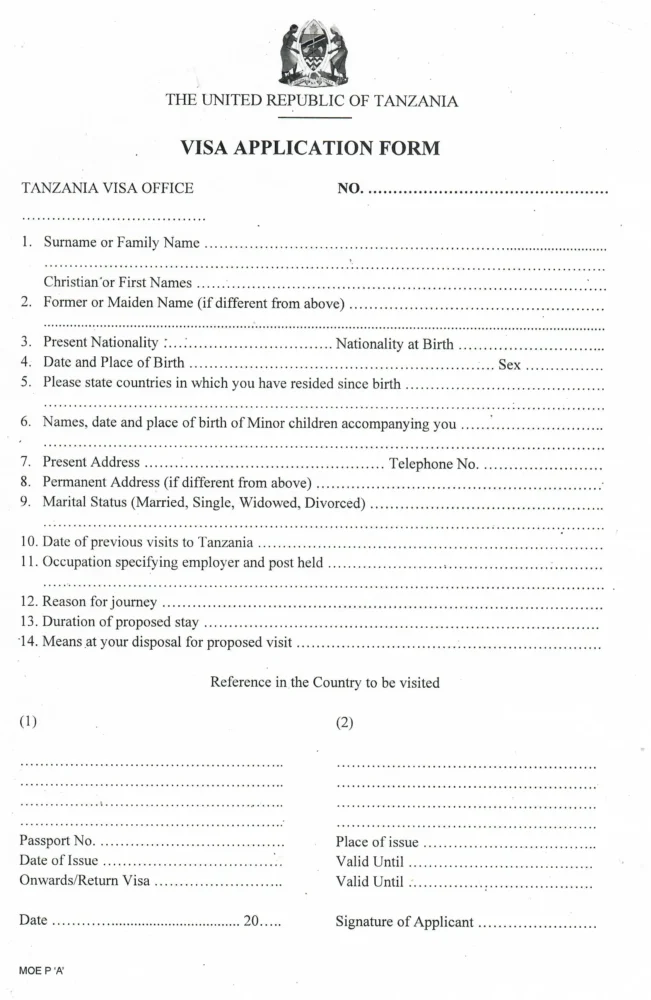
Download the Tanzania Visa Application Form (PDF) here.
Option 2: Visa on Arrival
You can also get your visa when you land at major entry points like Julius Nyerere International Airport (Dar es Salaam), Kilimanjaro International Airport, or Abeid Amani Karume International Airport (Zanzibar).
What you’ll need:
- Valid US passport (at least 6 months validity remaining)
- $100 USD in cash (exact change preferred also credit cards often may work)
- Return flight ticket confirmation
- Hotel/safari booking confirmation
The downsides:
- Long lines, especially during peak season when multiple international flights arrive simultaneously
- Potential for rejection if your paperwork isn’t in order (though rare for US citizens)
- Need to have exact cash on hand
- Processing can take 30-90 minutes depending on how many people are ahead of you
Expertise recommendation: Always go with the eVisa. The peace of mind is worth it, and you’ll breeze through immigration while others are stuck in the visa line.
Critical Requirements Every US Traveler Must Know
Your Passport Must Be Valid for 6 Months
This is non-negotiable and catches many travelers off guard. According to Tanzania Immigration Department regulations, your passport must be valid for at least 6 months from your date of arrival in Tanzania.
Example: If you’re arriving in Tanzania on March 1, 2026, your passport must not expire before September 1, 2026. If it expires on August 15, 2026, you’ll be denied entry even with a valid visa.
Expert tip: Renew your passport before applying for your eVisa if it’s close to the 6-month mark. Your visa is linked to your passport number, so if you renew after getting your visa, you’ll need to apply again with the new passport number.
Yellow Fever Vaccination Certificate (Sometimes Required)
Yellow fever vaccination is required if you’re arriving from a country with risk of yellow fever transmission or if you’ve spent more than 12 hours in transit through a yellow fever-endemic country’s airport.
When you need it:
- Flying from any South American country (Brazil, Colombia, etc.)
- Coming from certain African countries (Kenya, Uganda, Rwanda, Ethiopia)
- Connecting through a yellow fever country with a layover longer than 12 hours
When you DON’T need it:
- Flying direct from the United States
- Connecting through non-endemic countries (Qatar, UAE, Turkey)
- Short layovers (under 12 hours) in endemic countries
You’ll need to show your yellow WHO vaccination card at immigration if required. Many travelers get the vaccine anyway since it’s valid for life and opens up more travel options in the future.
Each Person Needs Their Own Visa (Including Children)
This one surprises a lot of families: every person entering Tanzania, including infants and children, must have their own separate visa application and pay the full $100 fee.
So, if you’re traveling as a family of four (two adults, two kids), you’re looking at $400 total in visa fees. There are no family discounts or child exemptions.
Important: Each child must have their own passport, even babies. If your child is listed in your passport but doesn’t have a separate passport document, they won’t be allowed to enter Tanzania.
5 Common Mistakes US Citizens Make (And How to Avoid Them)
After helping many American travelers navigate the Tanzania visa process, I’ve seen the same mistakes pop up again and again. Here’s how to avoid them:
Mistake #1: Selecting "Ordinary Visa" Instead of "Multiple Entry Visa"
This is the most common error on the eVisa application. The “Ordinary Visa” option is listed first and costs $50, so many Americans instinctively select it thinking they’re saving money.
What happens: Your application will be rejected, and you’ll have to reapply and pay again. The $50 fee is non-refundable, so you’ll be out $150 total.
The fix: When filling out the online application, scroll past the “Ordinary Visa” and select “Multiple Entry Visa” specifically. The form should show $100 USD as the fee. Double-check before submitting.
Mistake #2: Entering Incorrect Passport Details
Typos in your passport number, incorrect expiration date, or mismatched name spelling are surprisingly common and will get your application rejected.
The fix: Have your physical passport in front of you when filling out the application. Type slowly and carefully. Before submitting, review every single character of your passport number and expiration date against the actual document.
Mistake #3: Uploading Unclear or Wrong-Sized Photos
The eVisa system requires a digital passport photo and a scan of your passport bio page. Both must meet specific technical requirements:
- Passport photo: Recent (within 6 months), plain white background, front-facing, no glasses or hats, JPEG format
- Passport scan: Clear, color scan of the bio page, all four corners visible, no glare or shadows
The fix: Don’t use a selfie or cropped vacation photo. Use a proper passport photo service or take a photo against a plain white wall in good lighting. For the passport scan, use a scanner or a scanning app (CamScanner, Adobe Scan) rather than just taking a photo with your phone.
Mistake #4: Applying Too Late
The official processing time is up to 10 business days, but approvals can arrive on departure day or even during your flight. Some travelers have missed their safaris waiting for visa approval.
The fix: Apply at least 3-4 weeks before your departure. Peak safari season (June-October, December-February) sees processing delays, so build in extra time. If you’re traveling during high season, apply 6 weeks out to be safe.
Mistake #5: Forgetting to Print the Visa Grant Notice
Once approved, you’ll receive your Visa Grant Notice via email. Some travelers assume the email or a digital copy on their phone is enough.
What happens: While many immigration officers will accept a phone screenshot, some insist on a printed copy. If you can’t produce one and the officer is strict, you could face delays or be sent to get a visa on arrival (which means more fees and hassle).
The fix: Print out your Visa Grant Notice and keep it with your passport. Bring two copies, one for immigration and one as a backup. Also keep a digital copy on your phone and in your email, just in case.
Frequently Asked Questions from US Travelers
Can I apply for a single-entry visa if I promise I’m only visiting once?
No. This is not negotiable. According to the Tanzania Immigration Department policy, all US passport holders must obtain the multiple-entry visa regardless of their travel plans. There are zero exceptions, even if you write a letter explaining you’ll only visit once.
What if I’m visiting Tanzania as part of a multi-country trip?
Perfect, this is exactly when the multiple-entry visa shines. If you’re doing a Kenya-Tanzania combo safari, climbing Kilimanjaro, then visiting Rwanda, or any itinerary that involves crossing borders, you can enter Tanzania multiple times within the 12-month validity period without paying for a new visa each time.
Does the 12-month validity start from when I apply or when I arrive?
The 12-month period begins on the date your visa is issued (the date on your Visa Grant Notice), not the date you arrive in Tanzania. So if your visa is issued on January 1, 2026, it’s valid until December 31, 2026, regardless of when you actually travel.
Can I stay in Tanzania for 12 months straight?
No. The visa is valid for 12 months (meaning you can use it to enter Tanzania anytime within that year), but each individual stay is limited to 90 consecutive days. After 90 days, you must leave Tanzania and can re-enter again for another 90 days as long as your visa is still valid.
If you want to stay longer than 90 days continuously, you’ll need to apply for a residence permit through Tanzania Immigration Services.
Do I need separate visas for mainland Tanzania and Zanzibar?
No. Zanzibar is part of the United Republic of Tanzania, so your Tanzania visa covers both the mainland and the islands. One visa gets you access to Serengeti safaris, Kilimanjaro climbs, Zanzibar beaches, and everything in between.
However, be aware that as of October 1, 2024, Zanzibar now requires all visitors to have travel insurance. This is separate from the visa and must be purchased before arrival.
What if I lose my visa grant notice?
You can log back into the Tanzania eVisa portal using your application ID number and email address to download another copy. Always keep digital backups in your email and on your phone.
Can I extend my visa once I’m in Tanzania?
Tourist visas can sometimes be extended for up to 90 additional days. You’ll need to visit the Immigration Office in Dar es Salaam, Zanzibar, or Arusha before your current visa expires. Bring your passport, current visa, and proof of accommodation, and be prepared to explain why you need the extension. There’s no guarantee it will be approved, and it’s much easier to just plan your trip within the 90-day window.
Are there any other countries that require US citizens to get multiple-entry visas?
Yes, a few countries have similar reciprocity agreements with the US. For example, Pakistan charges US citizens $200 for a multiple-entry visa, and Ireland charges $100. These fees reflect the reciprocal treatment that citizens of those countries receive when applying for US visas.
The Bigger Picture: Why This Policy Exists
The $100 visa fee can feel like an unnecessary extra cost, especially when you see other travelers paying half as much. But understanding the “why” behind the policy helps it make more sense.
It's About Fairness, Not Profit
Tanzania isn’t singling out Americans to squeeze extra money out of them. The policy exists because of how the US treats Tanzanian visa applicants.
When a Tanzanian citizen wants to visit the United States, they must:
- Pay a non-refundable $160 application fee (whether approved or rejected)
- Attend an in-person interview at the US Embassy in Dar es Salaam
- Provide extensive documentation (bank statements, employment letters, property deeds)
- Wait weeks or months for a decision
- Face potential rejection without explanation or refund
Even if approved, Tanzanians receive a 12-month multiple-entry visa the same type Americans must get for Tanzania. From Tanzania’s perspective, the reciprocity is fair: you give us what we give you.
Supporting Tanzania's Growing Economy
Tourism is absolutely vital to Tanzania’s economy. According to official government data:
- Tourism contributed 17.2% of Tanzania’s GDP in 2023
- The sector employs over 1.5 million Tanzanians directly and indirectly
- Tourism revenue reached $3.9 billion in 2024, a critical source of foreign currency
Your $100 visa fee helps fund:
- Wildlife conservation efforts in national parks
- Anti-poaching patrols protecting elephants and rhinos
- Tourism infrastructure improvements (roads, airports, accommodations)
- Community development projects near protected areas
When you pay that fee, you’re not just getting a visa you’re contributing to the preservation of the incredible wildlife and landscapes that drew you to Tanzania in the first place.
Professional Advice: Is Tanzania Worth the $100 Visa?
After working with many American travelers, I can say this with complete confidence: not a single person has ever come back from Tanzania and complained about the visa fee.
Why? Because once you’re standing in the Serengeti watching a million wildebeest across the plains, or summiting Kilimanjaro at sunrise, or snorkeling with sea turtles off Zanzibar, that $100 feels like the best money you’ve ever spent.
Tanzania offers:
- The highest concentration of wildlife in Africa – nowhere else can compete with the Serengeti-Ngorongoro ecosystem
- Africa’s tallest mountain – Kilimanjaro is a bucket-list achievement
- World-class beaches and diving – Zanzibar, Pemba, and Mafia Island rival the Maldives
- Rich cultural experiences – 120+ ethnic groups, Swahili culture, Stone Town’s history
- Authentic, less-crowded safaris – especially in the southern and western circuits
The average American traveler spends $2,430 just on accommodation during a 10-night Tanzania trip, not including flights, safari costs, guides, or activities. In that context, the $100 visa represents about 4% of your total trip expenses.
And here’s the thing: because it’s a 12-month multiple-entry visa, you’re actually getting incredible value. Want to come back to see the calving season in February after witnessing the river crossings in August? You can, without paying another visa fee. Want to add a quick Kilimanjaro climb six months after your safari? Go for it.
Don't Let the Visa Fee Stop You
I’ve seen people hesitate about booking their Tanzania safari because of the visa cost. Don’t be that person. The memories you’ll make in Tanzania watching a lioness hunt at golden hour, standing on the roof of Africa, swimming in the turquoise waters of the Indian Ocean those are priceless.
The $100 visa fee is simply the price of admission to one of the world’s most extraordinary destinations. And compared to what you’ll spend on flights, safaris, and experiences, it’s a drop in the bucket.
So yes, US citizens pay double what other nationalities pay. But we also get a full year of unlimited entries to a country that’s home to some of the planet’s greatest natural wonders. When you frame it that way, it’s actually a pretty good deal.
Quick Action Steps: Getting Your Tanzania Visa Today
Ready to get started? Here’s your simple action plan:
- Check your passport validity: Make sure it’s valid for at least 6 months from your arrival date. Renew now if needed.
- Gather your documents: Passport scan, passport photo, flight details, hotel/safari bookings
- Apply online: Go to https://visa.immigration.go.tz/ and select “Multiple Entry Visa”
- Pay the $100 fee: Use a credit/debit card
- Wait for approval: Usually 3-10 business days
- Print your Visa Grant Notice: Keep it with your passport for immigration
- Pack your bags: the adventure of a lifetime awaits!
Remember: The $100 you spend on your Tanzania visa is an investment in one of the world’s greatest safari destinations. You’re not just buying a stamp in your passport; you’re unlocking a year of unlimited access to the Serengeti, Kilimanjaro, Zanzibar, and everything in between.
Tanzania is waiting. The Great Migration won’t wait. The summit of Kilimanjaro is calling. And those Zanzibar sunsets? They’re spectacular.
Get your visa, book your safari, and prepare for the journey of a lifetime. You won’t regret it.
Sources and References:
- Tanzania Immigration Services Official Guidelines
- US State Department – Tanzania Travel Information
- 2024 International Visitors’ Exit Survey Report – Bank of Tanzania, Ministry of Natural Resources and Tourism, National Bureau of Statistics
- Tanzania Association of Tour Operators (TATO) – 2024 Tourism Statistics
- TanzaniaInvest – Tourism Sector Reports 2024-2025
- World Tourism Organization (UNWTO) – World Tourism Barometer September 2024
Spread the Love, Share with Others
TRAVEL BLOG POSTS
No posts found!
BEST SELLING TOURS



Get Your Custom Safari Itinerary
Contact Information
Looking for a Tanzania safari? Talk to our Tanzania expert and plan your perfect trip!