
Northern Circuit Route: The Complete Climbing Guide
Umbwe Route Kilimanjaro: The Complete Climbing Guide
The Northern Circuit Route is the longest, most remote, and arguably the most spectacular route on Kilimanjaro. It takes 9 or 10 days and circles nearly the entire mountain, giving you views of Kilimanjaro from all angles and carrying you through landscapes that very few climbers ever see. It is also the route with the highest summit success rate of any trail on the mountain.
If you have the time and the budget, the Northern Circuit is the ultimate Kilimanjaro experience. You will have the northern slopes almost entirely to yourself. You will watch the light change over the mountain across different days and different perspectives. And you will arrive at the summit with more acclimatization behind you than any other route provides.
This guide tells you everything you need to know about the Northern Circuit, who it is for, what each day looks like, and why it stands apart from every other route on Kilimanjaro.
Download Your Free Kilimanjaro Packing Checklist
This comprehensive checklist includes everything on this page in an easy-to-print format you can use while packing. Simply check off items as you pack them to ensure nothing is forgotten.
Northern Circuit Route Kilimanjaro: Essential Facts & Key Statistics
| Essential Fact | Northern Circuit Route Key Detail |
|---|---|
| Start Gate | Londorossi Gate (2,100m / 6,890ft) — same as Lemosho |
| Summit | Uhuru Peak (5,895m / 19,341ft) |
| Distance | Approx. 98–110 km total — the longest Kilimanjaro route |
| Duration | 9 or 10 days |
| Difficulty | Moderate — longer and more remote but not steeper than Lemosho |
| Summit Success Rate | ~90–95%+ — the highest of any Kilimanjaro route |
| Crowd Level | Very low — the quietest route on the mountain |
| Accommodation | Tents (camping throughout) |
| Descent Route | Mweka Route |
| Best For | Experienced hikers, those wanting the best summit odds, lovers of wilderness |
What Makes the Northern Circuit Special?
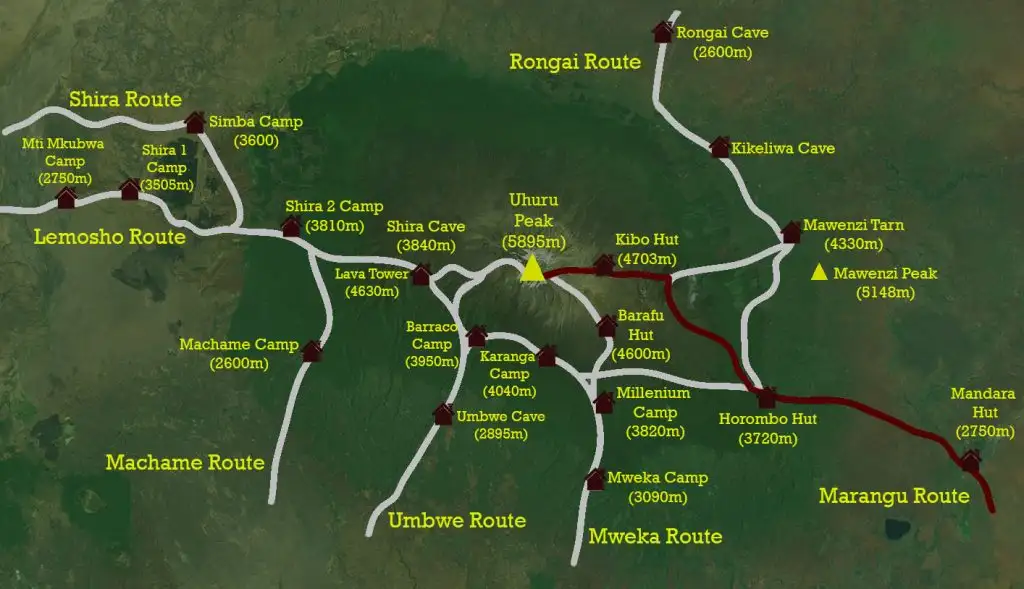
Most Kilimanjaro routes approach from the south or west and follow broadly similar paths once above 3,800m. The Northern Circuit is fundamentally different. After the first two days (shared with the Lemosho Route), the trail turns north instead of east. You spend several days traversing the remote, rarely visited northern slopes of the mountain, terrain that receives less than 5% of Kilimanjaro’s total annual climbing traffic.
- True 360-degree circumnavigation: The Northern Circuit circles the entire mountain. You see Kilimanjaro from the west, south, east, and north. No other route gives you this perspective.
- Highest summit success rate: The 9-day itinerary gives your body nine days to acclimatize—more than any other route. Summit success rates consistently exceed 90% with a good operator. Some climbers report rates above 95% on this route.
- Extraordinary solitude: The northern slopes receive a fraction of the traffic of the southern routes. For days 4 through 7, you may go an entire day without seeing another climbing group.
- Most diverse scenery: You traverse more ecological zones and see more varied landscapes on the Northern Circuit than on any other route. The contrast between the lush western approach, the open Shira Plateau, the stark northern slopes, and the classic southern summit approach is remarkable.
Why Umbwe Has a Lower Summit Success Rate
The Umbwe Route is short and steep. The 6-day itinerary gains altitude more rapidly than any other Kilimanjaro route. There is no acclimatisation day, no “climb high, sleep low” section like the Lava Tower Day on Machame and Lemosho.
On Umbwe, you gain roughly 1,000–1,200 metres of altitude each day for the first three days. Your body simply does not have enough time to produce the extra red blood cells and make the physiological adjustments needed for high altitude. The result: a higher rate of altitude sickness, earlier and more severe, and a higher rate of climbers having to turn back before the summit.
Understanding altitude sickness is essential before attempting Umbwe. Read our full Kilimanjaro Altitude Sickness guide before you decide.
Northern Circuit Route — Day-by-Day Itinerary (9 Days)
After gate registration, you walk through montane rainforest on a quiet, beautiful trail to Forest Camp. Because the Northern Circuit starts from the same point as Lemosho, these first two days are shared. The trail sees very few other climbers.
You exit the rainforest and climb up through heath and moorland onto the edge of the Shira Plateau. Kibo appears ahead for the first time. This is a full day with a significant altitude gain — walk slowly.
You cross the wide, open Shira Plateau — one of the most stunning landscapes on the mountain. This is where the Northern Circuit begins to diverge from the Lemosho Route. On Lemosho, Day 4 heads east toward Lava Tower. On the Northern Circuit, you have more time on the plateau. The Machame and Shira routes join here at Shira 2, so other climbers begin to appear.
Instead of heading east toward Lava Tower as Lemosho and Machame do, the Northern Circuit turns north. You cross the Shira Plateau and begin heading into the remote northern wilderness. Moir Hut is a small shelter used by very few climbers. The terrain here is open, windswept, and strikingly beautiful. You have entered the section of the mountain that most Kilimanjaro climbers never see.
You descend slightly today, which helps with acclimatisation. The northern slopes have a completely different character from the south — drier, more open, and with views of the Kenyan plains stretching to the horizon on clear days. Third Cave is a rarely visited camp. The remoteness here is absolute. Wildlife is occasionally seen on these slopes — eland and buffalo are possible.
The longest day of the Northern Circuit. You traverse the northern and eastern slopes, climbing steadily through barren, otherworldly alpine desert. The views of Mawenzi from this angle are extraordinary. School Hut at 4,700m is the highest camp before the summit. By this point you have been on the mountain for six days and your body has had exceptional time to acclimatise.
On some itineraries, Day 7 is used as an additional acclimatisation day with a short walk to higher ground before returning to camp. Some operators move to Barafu Camp via a different descent approach. Your guide will plan this based on your group's condition. This additional day is one reason Northern Circuit summit rates are so consistently high.
After eight days on the mountain, your body is as well prepared as it will ever be for the summit push. You climb at midnight, reach Stella Point at sunrise, and walk the final 45 minutes to Uhuru Peak. For most Northern Circuit climbers this is the most complete and rewarding summit experience available on Kilimanjaro — because you have truly earned it over nine days.
The final descent through the rainforest to Mweka Gate. Certificates are issued at the gate. Transfer to Arusha or Moshi. A very well-earned shower, meal, and rest awaits.
Northern Circuit vs Lemosho — Which Should You Choose?
Both routes start from Londorossi Gate and share the first two to three days. The Northern Circuit then turns north for four additional days of remote traversal before rejoining the summit route. Here is how they compare:
| Lemosho (8-day) | Northern Circuit (9-day) | |
|---|---|---|
| Days | 8 | 9–10 |
| Summit Success Rate | 85–95% | 90–95%+ |
| Crowds | Low to moderate | Very low |
| Unique Terrain | Shira Plateau, Barranco Wall | Full circumnavigation, northern slopes |
| Cost | High | Highest — extra days add cost |
| Best For | Best value for high success rate | Ultimate experience, max solitude |
Our recommendation: if you have 9 or 10 days and can handle the higher cost, the Northern Circuit is the finest Kilimanjaro experience available. If budget or time is a constraint, the 8-Day Lemosho is the next best option.
When to Climb the Northern Circuit Route
The Northern Circuit Route can be climbed year-round, and its length actually works in your favour when it comes to weather, with 9 to 10 days on the mountain, you have more flexibility to wait out a bad day than on shorter routes.
- Best months: January to March and June to October. These are the dry seasons with firm trails, clear skies, and the best overall visibility. The longer duration of the Northern Circuit makes good weather even more valuable — you want clear views of the northern slopes and the Kenyan plains, which are the highlights of this route.
- Avoid April and May: The long rains make trail conditions difficult across all Kilimanjaro routes. On the Northern Circuit, the remote northern slopes can become particularly challenging in wet weather with no nearby support. We recommend avoiding these months.
- November: The short rains bring some wet weather but the Northern Circuit handles this better than most routes. The northern slopes are naturally drier than the southern side, so conditions are often manageable for well-prepared climbers.
See our Best Time to Climb Kilimanjaro guide for detailed monthly advice.
Frequently Asked Questions — Northern Circuit Route
Time. Nine to ten days on the mountain gives your body the most acclimatization of any route. Each additional day at altitude, especially the days on the northern slopes where you maintain a high elevation without rapid gain, allows your body to produce more red blood cells, adjust breathing patterns, and build resilience. By summit night, you are better prepared than climbers on any shorter route.
Yes — in terms of technical difficulty, it is comparable to Lemosho. The terrain is not harder; the route is simply longer. If you can handle nine days of hiking with a daypack, it is accessible to well-prepared first-time Kilimanjaro climbers. The main barriers are cost and the time commitment.
The Northern Circuit Route is the most expensive Kilimanjaro route because of its length (more park fee days, more guide and porter days, more food and equipment). See our Kilimanjaro Climb Cost guide or contact us for a personalised quote.
Very nearly. The northern slopes receive roughly 5% of Lemosho’s traffic. On most days in this section, you will not share the trail or the campsite with any other group. This level of solitude on Kilimanjaro is extraordinary, most climbers who have done both Machame and Northern Circuit describe the northern section as something completely different and unforgettable.
No. The Northern Circuit does not go via Barranco Camp and therefore does not include the Barranco Wall scramble. The route rejoins the summit approach from the north side, not the south. If the Barranco Wall is something you specifically want to experience, the Lemosho or Machame routes include it.
Book the Northern Circuit With Exceptional Travel Expert
The Northern Circuit is a premium climb, and we plan it with the care it deserves. Private departures available year-round. Contact us to discuss dates, group sizes, and what is included.
Request Your Free Kilimanjaro Climb Proposal
The Northern Circuit Route guide was last updated in March 2026, based on our 10+ years of experience guiding climbers on the Lemosho Route to Uhuru Peak.
What Our Travelers Say
Posted on TripadvisorVerified Great service Just returned from the most incredible week in Tanzania. From the moment Jackline answered my first email to the final goodbye with our guide, everything was flawless. Exceptional Travel Expert truly lives up to its name.Posted on TripadvisorVerified Highly recommended! We did a combo trip, safari first with Shafi then straight into the Kili climb with Minja. Both were incredible in their own way. Shafi is so laid back and fun, Minja is focused and really gets you to the top. The coordination between everything by Exceptional Travel Expert was seamless. Jackline sorted all our booking questions before we flew out too, super helpful."Posted on TripadvisorVerified 10/10 Janeth helped us sort out all the logistics before our trip and was so thorough. She made sure we had the right gear list, knew what to expect, and even followed up a week before departure just to check everything was good. Little things like that make such a big difference. You can tell the whole team genuinely cares about your experience.Posted on TripadvisorVerified Excellent tour This was my first time in Africa and I was a bit nervous about it all. Jamali picked us up and straight away I felt relaxed. He answered all our silly questions without making us feel silly at all. Every day was perfectly planned and we never had a dull moment. I've already talked about five of my friends to go through Exceptional Travel Expert and ask for Jamali specifically.Posted on TripadvisorVerified Amazing experience Benson took us through the Serengeti and I genuinely felt like I had a friend showing me around, not just a guide. He reads the landscape like no one I've ever seen. Spotted a leopard in a tree that none of us would have noticed in a million years. The support team from Exceptional Travel Expert made sure everything ran perfectly in the background too.Posted on TripadvisorVerified Inquiry and Booking with Exceptional Travel Expert Before I even booked, I had a million questions and Jackline answered every single one so fast and clearly. I was emailing at odd hours and she always got back to me quickly. She made the whole planning process feel easy and stress free. Such a warm and professional person. Really set the tone for what ended up being an amazing trip.Posted on TripadvisorVerified Really great experience Jamali is something else. From day one you can tell this person really loves what they do. Super knowledgeable, funny, and always one step ahead. We saw the big five in three days and the whole time felt so smooth and well organized. The whole Exceptional Travel Expert team was fantastic but Jamali really stands out as a top guide, no question.Posted on TripadvisorVerified Exceptional Travel Expert – Seamless, Personalized, and Unforgettable Service Exceptional Travel Expert! From the very first consultation, the service was professional, attentive, and completely personalized. Every detail of the itinerary was thoughtfully planned, making the entire journey smooth and stress-free. Their knowledge of destinations, insider recommendations, and prompt communication truly set them apart. They went above and beyond to ensure a memorable experience, handling everything with care and expertise. I highly recommend their services to anyone seeking a seamless, well-organized, and unforgettable travel adventure.Posted on TripadvisorVerified Really great experience Honestly, I wasn't sure what to expect before this trip but wow, Shafi completely blew me away. He knew exactly where to find the animals and was so patient explaining everything to us. Never felt rushed. The guy has a real gift for making you feel like you're the only people on safari. Would 100% book again through Exceptional Travel Expert.Posted on TripadvisorVerified truly a five star experience Our experience with Exceptional Travel Expert was simply amazing. From the moment we landed, we felt taken care of. The team helped us with airport transfers, hotel bookings, and even recommended places to visit in Arusha. The safari itself was unforgettable, so many animals, beautiful scenery, and friendly people everywhere. The guide made sure we were comfortable and enjoying every moment. Truly a five-star experience!
Are you looking for a private safari or Kilimanjaro climb for your dates? Speak to our Tanzania expert to start planning your tailor-made holiday trip for your dates!
Send your inquiry now and our safari experts will reach out within 24 hours! – Let’s begin planning your Tanzania safari or Kilimanjaro climb!
